PC817X3NIP1B
PC817XxNSZ1B Series contains an IRED optically
coupled to a phototransistor.
It is packaged in a 4-pin DIP.
Input-output isolation voltage(rms) is 5kV.
Collector-emitter voltage is 80V.
CTR is 50% to 400% (at IF=5mA,VCE=5V,Ta=25?)
? Features
1.4-pin DIP package
2. Double transfer mold package
(Ideal for Flow Soldering)
3. High isolation voltage between input and output
(Viso (rms) :5kV)
4. High collector-emitter voltage(VCEO :80V)
5. Current transfer ratio
(CTR : MIN. 50% at IF=5 mA, VCE=5V ,Ta=25?)
6. RoHS directive compliant


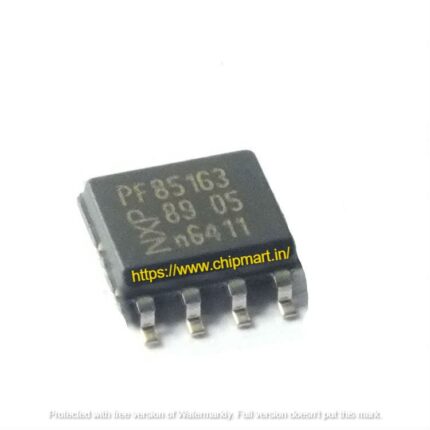
PCF85163D
Nearly any Liquid Crystal Display (LCD)1 with modest multiplex rates may be interfaced with the PCF85162 peripheral device. Any static or multiplexed LCD with up to four backplanes and up to 32 segments can have its driving signals generated by this device. For bigger LCD applications, it is simply cascaded. The two-line bidirectional I2 C-bus is used by the PCF85162 for communication with the majority of microcontrollers. A display RAM with auto-incremented addressing, hardware sub addressing, and display memory switching (static and duplex drive modes) all reduce communication overheads.
Features
LCD controller and driver on a single chip
Selectable display bias configuration: static, 12, or 13; Internal LCD bias generation with voltage-follower buffers; Selectable backplane drive configuration: static, 2, 3, or 4 backplane multiplexing; 32 segment drives:
Up to 8 14-segment alphanumeric characters, up to 16 7-segment numeric characters, and up to 128 components of any image
For storing display data, use 32 bits of RAM.
Flexible flashing modes; switching between display memory banks in static and duplex driving modes; and independent supply for LCD and logic voltage
Broad power supply range: 1.8 to 5.5 volts

PCF8563T
The PCF8563 is a CMOS1 Real-Time Clock (RTC) and calendar optimized for low power
consumption. A programmable clock output, interrupt output, and voltage-low detector are
also provided. All addresses and data are transferred serially via a two-line bidirectional
I
2C-bus. Maximum bus speed is 400 kbit/s. The register address is incremented
automatically after each written or read data byte.