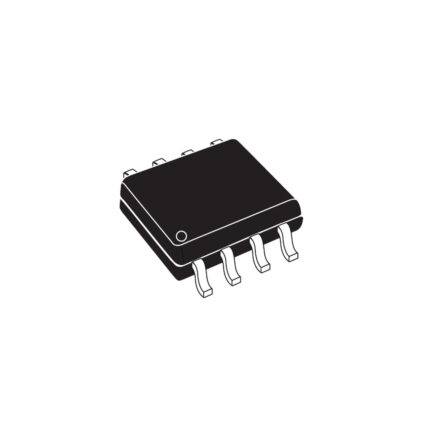
MAX689CSA
The 3.3V MAX687 automatically shuts down whenever
the output voltage drops below 2.96V. An internal
power-fail comparator also monitors the output and provides an early warning of low output voltage before the
device shuts down. When shut down, the output is
latched off until the ON input is pulsed. Turning off the
power supply in this way prevents battery damage due
to excessive discharge or cell-reversal. Typical applications include portable telephones and other battery-powered equipment where the power supply must be
disabled when the battery voltage is low.

MAX690AESA
MAX690A/MAX692A/MAX802L/MAX802M/MAX805L reduce the complication and quantity of materials necessary for power-supply monitoring and battery-control operations. When compared to separate ICs or discrete components, they significantly increase system dependability and precision. These components provide four purposes: 1) During power-up, power-down, and brownout scenarios, a reset output is provided. 2) Battery-backed logic switching for CMOS RAM, CMOSP, and other low-power logic. 3) If the optional watchdog timer has not been toggled within 1.6 seconds, a reset pulse is sent. 4) A 1.25V threshold sensor for power-failure detection, low-battery detection, or monitoring a power supply other than 5V. The reset-voltage threshold levels and reset outputs of the parts differ. When the supply voltage dips below 4.65V, the MAX690A/MAX802L/MAX805L generate a reset pulse, while the MAX692A/MAX802M produce a reset pulse once the supply voltage goes below 4.40V.

MAX690CPA
The MAX690, MAX692, and MAX694 are supplied in
8-pin packages and provide four functions:
? A reset output during power-up, power-down, and
brownout conditions.
? Battery backup switching for CMOS RAM, CMOS
microprocessor or other low power logic.
? A Reset pulse if the optional watchdog timer has not
been toggled within a specified time.
? A 1.3V threshold detector for power fail warning, low
battery detection, or to monitor a power supply other
than 5V

MAX691ACWE
The MAX691A/MAX693A/MAX800L/MAX800M microprocessor (?P) supervisory circuits are pin-compatible
upgrades to the MAX691, MAX693, and MAX695. They
improve performance with 30?A supply current, 200ms
typ reset active delay on power-up, and 6ns chip-enable
propagation delay. Features include write protection
of CMOS RAM or EEPROM, separate watchdog outputs, backup-battery switchover, and a RESET output
that is valid with VCC down to 1V. The MAX691A/
MAX800L have a 4.65V typical reset-threshold voltage,
and the MAX693A/MAX800Ms? reset threshold is 4.4V
typical. The MAX800L/MAX800M guarantee power-fail
accuracies to ?2%

MAX691EWE
The MAX690 family of supervisory circuits reduces the
complexity and number of components required for
power supply monitoring and battery control functions in
microprocessor systems. These include ?P reset and
backup-battery switchover, watchdog timer, CMOS RAM
write protection, and power-failure warning. The MAX690
family significantly improves system reliability and accuracy compared to that obtainable with separate ICs or
discrete components.

MAX693AEWE-T
The MAX691A/MAX693A/MAX800L/MAX800M microprocessor (?P) supervisory circuits are pin-compatible
upgrades to the MAX691, MAX693, and MAX695. They
improve performance with 30?A supply current, 200ms
typ reset active delay on power-up, and 6ns chip-enable
propagation delay. Features include write protection
of CMOS RAM or EEPROM, separate watchdog outputs, backup-battery switchover, and a RESET output
that is valid with VCC down to 1V. The MAX691A/
MAX800L have a 4.65V typical reset-threshold voltage,
and the MAX693A/MAX800Ms? reset threshold is 4.4V
typical. The MAX800L/MAX800M guarantee power-fail
accuracies to ?2%
MAX705CSA
The MAX705?MAX708/MAX813L microprocessor (?P)
supervisory circuits reduce the complexity and number of
components required to monitor power-supply and battery
functions in ?P systems. These devices significantly improve
system reliability and accuracy compared to separate ICs or
discrete components.
The MAX705/MAX706/MAX813L provide four functions:
1) A reset output during power-up, power-down, and
brownout conditions.
2) An independent watchdog output that goes low if
the watchdog input has not been toggled within 1.6
seconds.
3) A 1.25V threshold detector for power-fail warning, lowbattery detection, or for monitoring a power supply
other than 5V.
4) An active-low manual-reset input.

MAX705ESA-T
? Supervisory-Function Integration Significantly
Improves System Reliability While Reducing Board
Space
? ?MAX Package
? Guaranteed RESET Valid at VCC = 1V
- 200ms Reset Pulse Width
- Debounced TTL/CMOS-Compatible ManualReset Input
- Active-High Reset Output (MAX707/MAX708/
MAX813L)
? Precision-Supply Voltage Monitor
- 4.65V (MAX705/MAX707/MAX813L)
- 4.40V (MAX706/MAX708)
? Voltage Monitor for Power-Fail or Low-Battery
Warning

MAX707CSA-T
The MAX705?MAX708/MAX813L microprocessor (?P)
supervisory circuits reduce the complexity and number of
components required to monitor power-supply and battery
functions in ?P systems. These devices significantly improve
system reliability and accuracy compared to separate ICs or
discrete components.
The MAX705/MAX706/MAX813L provide four functions:
1) A reset output during power-up, power-down, and
brownout conditions.
2) An independent watchdog output that goes low if
the watchdog input has not been toggled within 1.6
seconds.
3) A 1.25V threshold detector for power-fail warning, lowbattery detection, or for monitoring a power supply
other than 5V.
4) An active-low manual-reset input
MAX712CSE
The MAX712/MAX713 fast-charge Nickel Metal Hydride
(NiMH) and Nickel Cadmium (NiCd) batteries from a DC
source at least 1.5V higher than the maximum battery
voltage. 1 to 16 series cells can be charged at rates up
to 4C. A voltage-slope detecting analog-to-digital converter, timer, and temperature window comparator determine
charge completion. The MAX712/MAX713 are powered
by the DC source via an on-board 5V shunt regulator.
They draw a maximum of 5?A from the battery when not
charging. A low-side current-sense resistor allows the
battery charge current to be regulated while still
supplying power to the battery?s load.